


“A Sonnet Does More Than a Three-Act Play”: Daryl Ponicsan on the Difficulty of Simplicity
A new literary venture is afoot with the publication of Daryl Ponicsan’s collection, “Heat Deflectors,” a mosaic of a work published by the independent Stairway Press. Long celebrated for his keen eye on American life, perhaps most famously in his foundational novels The Last Detail and Cinderella Liberty, Ponicsan here embraces a radically compressed form: a hundred “short-short stories.”
This numerical constraint, which Ponicsan describes not as a limitation but a “goal,” forces a fierce economy of language, cementing his reputation for “mastery of brevity.” The author likens this form to the poetic discipline of the haiku, aiming to capture a fleeting narrative moment within minimal space. As he explains, “Sometimes a sonnet does more than a three-act play.” The stories themselves, some drawn from decades of his work, span a vast historical and demographic range, charting a course from 1900 to the present and featuring a diverse cast across genders and life stages.
The evocative title, “Heat Deflectors,” speaks to a central theme: the stories themselves function as momentary barriers, “designed to insulate the reader for a moment” from the world’s harsh realities. This collection finds Ponicsan, a writer consistently drawn to the themes of human redemption and the essential “journey” in fiction, moving beyond the military camaraderie of his early work to explore a broader human tapestry, one threadbare and interconnected. His decision to partner with Stairway Press signifies a preference for intimacy and fairness, echoing his belief that in publishing, “bigger is not better.”
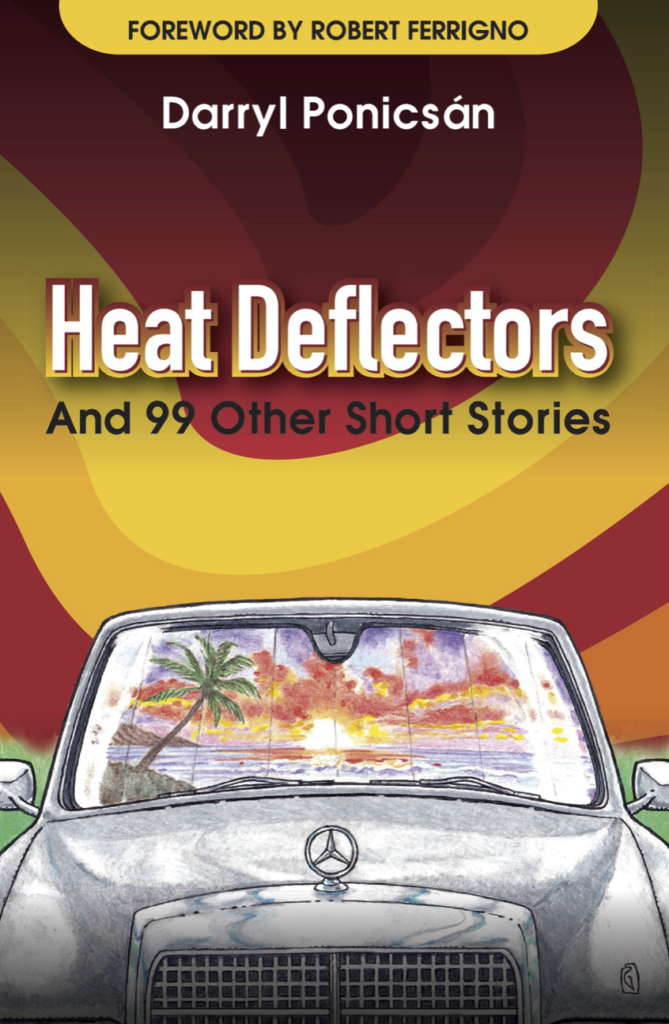
The collection’s subtitle, “and 99 Other Short Stories,” explicitly foregrounds its numerical structure. How did the constraint of 100 “short-short stories” influence your approach to narrative, character, and theme? Do you view this formal limitation as a post-structuralist exercise in de-emphasizing the traditional arc in favor of fragmented, self-contained moments?
Darryl Ponicsan: I never thought of 100 as being a constraint, but simply a goal. The number could have been 82, but when you reach 82 what is another 18? 100 is a comforting number, yet startling as applied to a collection of short stories. Still, some of these threads coalesced into a traditional character arc. For example, the child abandoned by her father who discovers that he lived within walking distance during all of her formative years.
You’ve been praised for your “mastery of brevity.” In Heat Deflectors, you apply this to a mosaic of characters spanning different genders, ethnicities, and life stages. How did you navigate the challenge of creating authentic, fully realized human moments in such limited space without resorting to stereotype or caricature? Could you discuss your process for distilling a character’s essence to just a few hundred words?
One watches a character in a defining moment and builds upon that observation to create a short story. Not to say it is easy, but it is not rocket science. Brevity and simplicity are what is difficult. I’ve always loved the haiku as a poetic form. In fact, these stories may have come from my trying to write haikus. Most haikus capture a fleeting moment in nature. I tried to fit a narrative within 17 syllables, which may be asking too much. Most stories and movies take too long to tell. Yes, the language of Fitzgerald and Updike is lovely to wade into, but Hemingway walks on water and leaves a wake. One of the characters in the collection is a writer who feels cursed by Hemingway, who condemns him on behalf of all struggling writers. That comes from the frustration of failing to eliminate the unnecessary in stories, a practice E. H. made look easy.
The collection features a range of literary allusions and cameo appearances from figures like Jackson Pollock and Carlos Castaneda. What is the function of these figures? Are they merely postmodern playfulness, or do they serve as thematic anchors, offering a metatextual commentary on art, philosophy, and the creative process within the stories themselves?
The editor of my last novel (“Eternal Sojourners,” Skyhorse Press) outed me as a metatextual, but I have never quite grasped the spectrum of meta, para, and intertextualism. I am not a fan of Jackson Pollock, which in arty circles makes me a barbarian. I wanted, in a couple of shorts, to dramatize all that I know and believe about him: that he was an insecure drunk living in fear of being exposed as a fraud. Carlos Castaneda was a close friend who I always thought should be a fictional character. Though postmortem accusations sullied his legacy, I still feel nourished by the time I spent with him. He was self-effacing, with a droll sense of humor, about his fame and all that came with it. I simply wanted to include him in my cast of characters.

The title, “Heat Deflectors,” is evocative but ambiguous. In a collection that explores a wide array of human experiences—from the tragic to the humorous—what are these “heat deflectors”? Are they the fleeting moments of grace, the defense mechanisms of your characters, or perhaps the stories themselves, deflecting the harsh realities of life?
In a word, yes. All of the above. The title story clearly uses actual heat deflectors to block the desert sun, while the protagonist improvises barriers to emotional involvement. And the collection itself is designed to insulate the reader for a moment. Reading, like any other endeavor, requires blocks of time. My stories, however, are so brief that the odd moment on public transportation or in a doctor’s waiting room is enough to deflect any distraction or heat from the rest of the world.
Several characters reappear across multiple stories. This technique suggests a hidden coherence or larger narrative arc within the collection’s fragmentation. Could you elaborate on your intention behind this? Is it an attempt to create a sense of cyclical time or to imply a more traditional novelistic structure within a collection of short narratives?
Mostly accidental. More intentional are the repeated uses of certain locales. Paris and Malta, for example, two places dear to my experience, and of course Palm Springs, my desert home, where heat is a character, much like Paris takes on the role of a character in any story set there. You cannot deflect Paris.
In many of your works, from “The Last Detail” to “Last Flag Flying,” you’ve masterfully explored themes of male camaraderie and the military experience. “Heat Deflectors” shifts to a much broader, more diverse cast of characters. Was this a conscious departure from your earlier work, and what new insights into the human condition did this expanded canvas allow you to explore?
Ask any veteran to name the most positive aspect of military life, from the trenches to the high seas, and the answer will be camaraderie. The short stories have some of that when they involve veterans, but as you noted, these cover much different ground and a wider cast over a longer period of time. In that regard, some of these stories are my “earlier” work; in fact, my earliest work, done during grad school. You will notice several have campus locales and look at the pointy edges of young love.
The stories cover a period from 1900 to the present. The temporal scope, combined with the diverse geographical settings, creates a sense of a vast, interconnected human tapestry. How do you see the individual threads of these short-shorts weaving together? Do you believe a single collection can provide a meaningful historical and cultural critique?
For the most part, randomly. There was no intention of the collection providing a meaningful historical and cultural critique. Of what? I wonder.
Your writing, particularly in your early novels, is known for its “pithy, satirical” quality and “truer-than-true snapshots of real life.” How do these elements manifest in the compressed form of “Heat Deflectors,” where there is less space for extended dialogue and scene-setting?
The answer is in the epigram, “Only a dew drop, but within… turmoil.” Sometimes a sonnet does more than a three-act play. A poem can affect the reader more than a thousand-page novel. For the reader, it is a large return on a small investment.
Stairway Press has also published your collected edition of “The Last Detail” and “Cinderella Liberty.” Given your long and successful career in both literature and film, what does your relationship with a smaller, independent press like Stairway signify? Does it allow for a different kind of creative freedom or a return to a more intimate relationship with your work?
The conclusion I am approaching here is that bigger is not better. Stairway does an excellent production with limited resources. They are limited in what they can do in promotion, but even the big publishers have foisted off the heavy lifting to the authors, demanding they establish and grow platforms on social media and campaign there for their books. Some writers have a talent for self-promotion; most do not, myself included. Stairway’s contract should be a model for all publishers. A one-page simple document that does not require review by a lawyer and is fair and advantageous to the writer.
The concept of the “spiritual sequel” is integral to the connection between “The Last Detail” and “Last Flag Flying.” How does the notion of a story’s “spirit” or core essence evolving over time, rather than in direct narrative continuation, inform your writing? Could this be a lens through which to view your entire body of work?
It was never meant to be a spiritual sequel; it was supposed to be an actual sequel. Some history: during Bush Jr.’s misadventure in Iraq, a producer friend of mine wondered how the two escorts in TLD were doing. I had no intention of doing a sequel, but it is an interesting exercise to revisit characters after decades. I pointed out that the ending of TLD made a sequel not possible. Tom Wright, the producer, made the case that the ending of the movie left the door open for a sequel. Sony had the sequel rights and they passed. Paramount was keen on it and told us to put together the cast and director. Tom argued that we should have more than an idea for Jack Nicholson and Randy Quaid to mull over. He urged me to write it as a novel, same structure and length and style. I have always said that in military life anything is possible, so now prove it. I wrote the novel in just a few months. Paramount commissioned the screenplay. For me, the only way this could work was with Nicholson and Quaid. Quaid was all for it, but Nicholson was reluctant. We got a director on board, Rick Linklater, and things were looking good, but Jack could not overcome his reluctance. The project collapsed, but I understood and was not all that upset by it. Ten or twelve years passed and Amazon asked Rick if he had any favorite scripts he could never get made. He showed them LFF and they were in. It was at that point that I said I could not bear to see a sequel of TLD with other than the originals playing the parts. We came up with the idea of changing their names and backstories. I do not know who first labeled it a spiritual sequel or an homage to Hal Ashby. I hate sequels motivated by box office, but an interval of 20 or 40 years stokes me. I did the first draft of the sequel to “The Hustler.” That sequel made perfect sense to me. But I was fired because I insisted you cannot do a sequel to “The Hustler” that does not include Minnesota Fats. Paul Newman did not like Jackie Gleason, and Scorsese wanted no reference at all to anything having happened to the characters years before. I still think it was a big mistake and a golden opportunity missed. So back to your question, yes, any writer’s body of work can be rethought over decades or marination and seen in a new and pleasurable way.
Your 1975 novel “The Accomplice” is a crime fiction narrative, a genre you have also written in under the pseudonym Anne Argula. How does writing in a genre with specific conventions—such as crime and mystery—contrast with the more experimental, vignette-based form of Heat Deflectors? Do these different modes of writing satisfy different creative impulses?
Honestly, I do not know how to write genre stuff. It is not a matter of creative impulses but the best way to tell the story. For example, any idea I might have initially appears as either a movie, novel, or short story. “The Accomplice” is closely based on a real event, and my source was the DA involved in the case. I approached it as I would any other story. I never thought of it as crime genre. When the idea for “Homicide My Own” took hold, I saw it as a movie, but I was out of the business and had no contacts, so I wrote it as a novel, under a feminine name, with a feminine narrator. I did no research of the demands of the crime genre, I just tried to get it down on paper.
Your work has a consistent focus on the journey, both literal and figurative. From the cross-country odyssey in “The Last Detail” to the psychological explorations in “Heat Deflectors,” the idea of characters in transit seems paramount. What is it about the concept of journeying that you find so compelling?
Isn’t the journey the bedrock of fiction? Getting from Point A to Point Z is a fine frame for any story, and then there is the inner journey. Both compelling reasons to read or write a story.
You transitioned from teaching to a full-time writing career following the success of your debut novel. How did your background as an educator and your time in social work and the Navy influence your narrative perspective, particularly your keen insight into the human condition and your ability to capture authentic dialogue?
Human redemption is a theme I am drawn to. I knew from an early age that I could never work for a profit-making organization. My time as a teacher and a social worker was difficult but rewarding. The Navy gave me something to write about, but teaching and social work gave me heart. An ear for dialogue was developed during my formative years in a coal-mining town in NE Pennsylvania, an environment rich in drama and comedy.

The line between fiction and autobiography in “Heat Deflectors” seems deliberately blurred, as the publisher notes many stories are “deeply personal.” What is the ethical and aesthetic line you draw when transforming personal experience into fiction, especially in a collection that purports to be “fully realized short stories” rather than just “vignettes or slices of life”?
It is always personal. I do not admire those writers who research the hell out of a subject then build a story around it. I prefer those who dive headlong into personal experience and wrestle it down to the page. From the adventures of Ernest Hemingway to the more ordinary experiences of Anne Tyler.
Interview and introduction by Klemen Breznikar
It’s Psychedelic Baby! Magazine