


Kristen Lolatte’s Fiona Trilogy: Unnoticed, Unseen, Unforgettable
There is a distinct intimacy to Kristen Lolatte’s Fiona trilogy, yet the scope is vast, as though drawn from a private weather system and suddenly unleashed. That impression is by design. When Lolatte speaks of these books, she sounds like a woman describing an actual life, not a mere manuscript. “My home is Fiona’s home,” she says. These novels are set in an intimate domestic world of books, herbs, tea, and ritual.
Born in Brattleboro, Vermont, in 1969, Lolatte has lived enough lives to understand that the imagination is rarely nourished by one path alone. Bookselling, teaching, corporate work, the daily rhythms of a farmhouse in Maine shared with her son and three cats, all of it has fed the fiction. So too has her unlikely partnership with Ken Coffman, the engineer, entrepreneur, publisher, and wandering polymath whose own biography is fascinating. Their collaboration has an interesting start. He saw in her what she had not yet fully claimed in herself. She, in turn, found in him the catalyst that turned thought into form.
“The book wrote itself,” she says, and while that may sound like a mystical flourish, it also points to something more exacting. Real co-writing requires surrender, trust, instinct, and nerve.
What emerges in the trilogy is a voice that feels singular without being simple. Lolatte is clear that the books are rooted in lived experience, but they are not reducible to autobiography. Rather, they transform the textures of an ordinary life into myth. There is a quiet seriousness in that act, a refusal to pretend that grandeur must arrive dressed in spectacle.
The books understand that the domestic and the epic are not opposites. A kitchen can be as fateful as a battlefield. A farmhouse can contain a kingdom. A woman who prefers to move “unnoticed, unseen” can still become the axis on which a world turns.
That, finally, is the emotional intelligence at the heart of these novels. They do not glorify power. They ask what it costs to carry responsibility, and what remains when struggle is over. Lolatte’s answer is unshowy and hard-won. The “quiet center” of the trilogy is “believing in yourself.” In fiction as in life, that may be the more radical proposition.
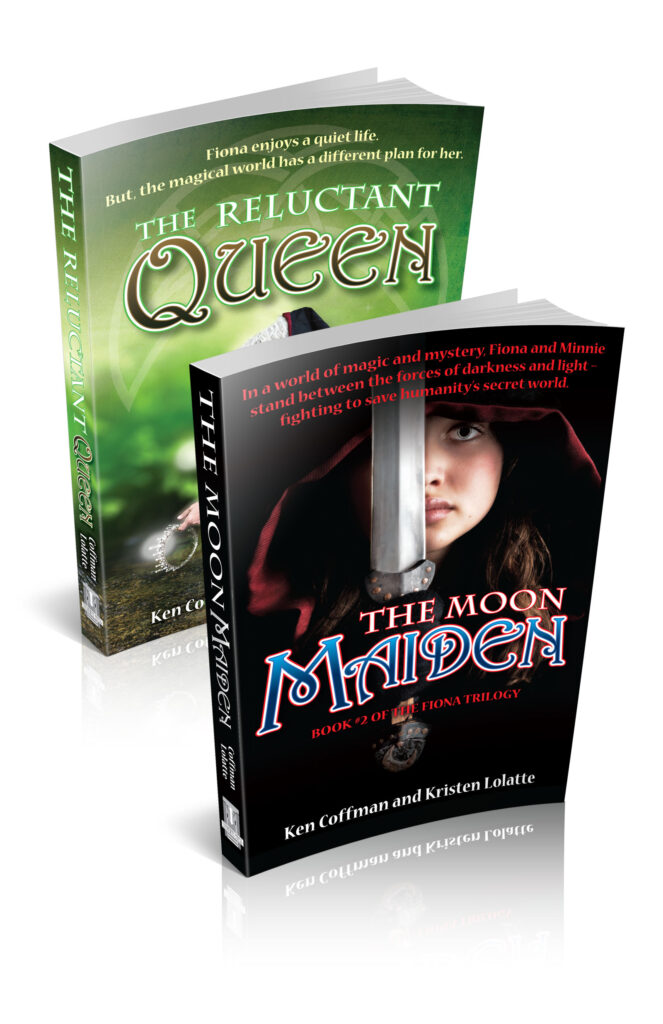
You spent years working in bookstores, teaching, and later navigating corporate life before the Fiona novels emerged. Looking back, do you see those earlier chapters less as detours and more as the terrain that quietly prepared the imaginative landscape of these books?
When I first met Ken, it was when we were both working in the corporate world. I’d never worked in a corporate capacity like that before and it sure was eye opening. It taught me a lot; both how I wanted to be and how I never wanted to be. In looking back, it helped to shape me for sure. Did it help to shape the trilogy? I dare say, without that experience the trilogy would never have been born because I never would have met Ken.
If I had to look at it objectively, it sort of mirrors my life. Bookstore days equate to book 1, corporate equates to book 2, and now that I’m teaching that equates to book 3. Not directly mind you, but the undercurrents are there to be sure.
Writers often describe a moment when writing stops being a private aspiration and becomes an unavoidable necessity. Was there a particular turning point when you felt the Fiona story was no longer optional, that it had begun insisting on being written?
To be honest, I’d say that was the entire Fiona journey. Ken will attest to this as well. The book wrote itself. Inspiration for both of us came from somewhere outside of time, outside of ourselves. For example, Ken would email an idea for a chapter. I would usually sit on it for a day or two and then I would be compelled to pull out the laptop and start typing. I wouldn’t have any idea going in but the words would just fly out.
You live in a two-century-old farmhouse in Maine, a setting steeped in continuity and weathered time. How much does that sense of historical layering influence the texture of the trilogy’s world?
Ken would always tell me, “This isn’t your autobiography,” but truth be told, it very much is my story. My home is Fiona’s home. My being is very much Fiona. The cast of characters, the various settings, even Luna the cat was my cat. The purple punch buggy that Fiona drove was an ode to my high school English teacher. I could point to countless examples of people, places, events, rituals, and yes, even her house. I suppose we write best what we know about, and in my case, I wrote about me and my life.
Your collaboration with Ken Coffman began not in a literary circle but through correspondence. What surprised you most about discovering a creative partnership in a place where you weren’t looking for one?
What surprised me the most was that Ken thought I could even write! Our only correspondence had ever been through work emails. I’d honestly not written anything since college papers, so how he managed to pick up on that is beyond me. But he did and it turned into a most extraordinary partnership. For two lone wolves to come together and form one voice is beyond explanation.
When two writers share narrative authority, disagreements are inevitable. Over the course of the trilogy, did you develop a philosophy for resolving creative tension, or did each book require its own negotiation?
To be honest, I only recall one argument, and it was a minor one at that. It was in book one. I wanted Luna the cat to be a female and Ken insisted that it be a male character. He gave me a reason, but I can’t even remember what it was. Aside from that, I don’t recall any problems. That may be because I let him be the maestro; I just wanted to write. He directed and had the vision and what he said all made sense.
Readers often wonder whether a co-written work blends voices into anonymity or produces a new, shared voice distinct from either author. At what point did you feel the Fiona trilogy had found that third voice?
As I mentioned above, I feel like we somehow became one voice. I don’t know how it happened. I know what parts I wrote, I know what parts Ken wrote, but when other people read it, they can’t tell where one voice ends and the other begins. To be sure, friends of mine will be like “Oh, I know Ken wrote that part, that doesn’t sound like you,” but aside from that, they truly can’t tell. Even when Ken would edit my chapters, he did so in such a way that it maintained my voice. One voice throughout the entire trilogy.
Across the trilogy, power repeatedly comes to characters who never asked for it. What drew you to the drama of reluctant leadership rather than the traditional fantasy arc of heroism?
I honestly don’t know how that idea came about; I think it was Ken’s idea? But, if I’m speaking for myself, I’ve never liked the spotlight. I like to move about the world unnoticed, unseen. So that is very much a trait of mine; reluctant leadership.
Fiona and Minnie both confront the unsettling realization that personal safety and moral responsibility cannot coexist indefinitely. Were you consciously exploring the psychological cost of being “chosen,” or did that theme emerge naturally as the characters developed?
As Ken was the maestro, perhaps he was consciously exploring that aspect, I however was not. So, for my part, I’d say that it naturally emerged as the characters developed and went on their journeys. One of my favorite books is Illusions by Richard Bach. It’s the story of a reluctant messiah. I’ve read it so many times, it’s part of my being. Maybe that came through without me even knowing?
The antagonist’s ambitions are vast, yet the emotional stakes of the books often remain intimate, rooted in friendship, guardianship, and survival. Was maintaining that balance between epic scale and human closeness one of the central structural challenges of the series?
I’d be willing to bet that was a central structural challenge for Ken. I had the pleasure of just being able to write; he had the task of weaving it all together. I recall that there were times when he would muse about an epic battle, this, that, and the other. And there was me, frolicking in the forest with the magical beasts and wanting everyone to be happy. So I suspect he had his hands full trying to map it all out.

Fiona begins the story in a domestic world defined by books, herbs, tea, and quiet rituals. Were you intentionally opening an epic fantasy from a place of stillness to suggest that transformation begins in private life before it reaches the battlefield?
I think, for me, not knowing fully where the story was going, I had to start with what I knew. At that point, I’m not even sure if we knew that it was going to be a trilogy. Like Fiona, my home is filled with books and eclectic wares, I grow herbs in my garden and use them for medicinal teas. There are always incense or candles burning. It’s a place of calm and stillness; a sanctuary in a crazy world. So again, life imitates art I suppose. We center ourselves in our homes before we venture out into the crazy world every day. Fiona’s world is no different.
Fiona’s hesitation to accept destiny shapes the novel’s pacing. Did writing a protagonist who resists the story’s forward momentum force you to rethink conventional plot propulsion?
To be honest, I don’t think when I write. I simply write. Perhaps if I had to write on my own, I’d have thought more strategically about it all, but thankfully Ken took control. Ken and I are anything but conventional so I suppose it makes complete sense that we didn’t follow any streamlined way of writing. In that fashion, it became a much more organic process, open to the whims of the muse.
In Moon Maiden, Minnie’s coming-of-age unfolds under the pressure of secrecy and exile. What interests you most about adolescence as a narrative space, particularly when layered with magical inheritance and political danger?
Adolescence is such a dreadful time. I see it again now since I’m a teacher. I think both Ken and I wanted to create a safe, empowering space for young girls. Create a space where misfits felt less odd. A space where girls could feel empowered, not by being popular, but by being true to themselves. We wanted to show young girls that it’s ok to seek out like-minded people and that they will become your people. Your tribe, your pack will become your safety, your family.
Minnie’s inability to freely use her magic introduces restraint as a central dramatic engine. How does limitation, rather than ability, become the force that defines a character’s growth?
I think that when you take away something that you’re good at, something that is naturally a part of you, you have to find your other strengths. You can’t take the easy route; you have to work. It’s not always fun, but that’s where the growth lies.
When you began the first book, did you already envision the trilogy’s final destination, or did the ending reveal itself gradually as Fiona and Minnie evolved?
I don’t think either of us envisioned this at all to be honest. I remember at some point Ken saying this would be a trilogy, and I had no idea how. I think it was towards the end of book one when we realized that there was more to tell. Fiona had more to share.
The New Age suggests transformation. Without revealing plot specifics, what kind of “new age” were you most interested in exploring: political renewal, spiritual change, or the quieter reinvention that follows survival?
Kristen Lolatte: For me, I gravitated towards the quieter reinvention that follows survival. I’m definitely not a political person and I believe spirituality is a personal journey. I like to see what follows next. After the long hard journey, where to now? What happens? How did it all tie up? Was it worth it in the end?
What proved most difficult in bringing the trilogy to completion: resolving the external conflict, or finding the truth that would allow the characters to step beyond the story?
That is a great question and not one that I know how to answer. Book 3 felt like it took forever to write, but that was because of life getting in the way. I feel like the trilogy wrapped up in such an unexpected way that maybe it was just something else completely, though what that is, I can’t even be sure.
Did writing the concluding volume change how you now understand the earlier books? In retrospect, do you see seeds planted in The Reluctant Queen that only revealed their meaning while writing the final pages of the trilogy?
I wanted to remain true to Fiona and who she was as a person. I think those tenets ran through the entire trilogy. I feel that as a character Fiona had come full circle. She had loved and lost; she had walked through the fire and survived. By the end she was tired and wanted to reclaim her peace. As Queen, she was granted her peace until the end of her days.
Many fantasy series end with victory, yet readers often remember the aftermath more vividly than the triumph itself. In shaping the last novel, were you interested in what happens after destiny has been fulfilled, when characters must learn how to live with what they have become?
Yes, I wanted to see it all come full circle. I wanted that classic “happy ending” where the world was righted, and evil was put to rest. The world needs stories like that, especially now. There is so much happening in the world today; we need to believe that there is still light in the world, that good things can still happen.
When readers encounter the three books together, what do you hope they experience that cannot be felt by reading a single installment in isolation?
I want them to step into Fiona’s world and walk with her to the end. I want them to become invested, and feel the love and the hatred, the disgust and the loathing. I want them to experience all of the worlds, because the magic doesn’t exist in one single book. To gain the full experience you must jump in with both feet and don’t stop swimming until the very end.
Looking across The Reluctant Queen, Moon Maiden, and the final one, what thematic thread feels to you like the trilogy’s quiet center, the idea that remained constant even as the narrative world expanded?
For me, the quiet center is believing in yourself. That you can do hard things. That the world will deal you a horrible hand and you can’t give up. You can’t let “them” win. You have to try. And you don’t always have to be loud in your trying. You can make small moves, but move you must. Giving in to despair is easier sometimes than getting up and moving, but you must move. As long as there is a glowing ember in you, you must fan it and keep going. The light is your center.
Now that the Fiona trilogy stands complete, do you feel a sense of farewell to these characters, or do fictional worlds continue to exist for you long after the final sentence has been written?
Fiona definitely lives on. As I’ve said before, Fiona and I are one. I have a fair bit of Minnie in me as well, but Fiona is strong. She floats about me, in my periphery. The closing chapter is especially dear to me, as I hope that will be my dream someday.
Fantasy literature often asks whether power corrupts, but your trilogy repeatedly asks a different question: what kind of courage is required to accept responsibility at all? After living with Fiona and Minnie for the span of three novels, how has your own understanding of courage changed?
I believe that courage is in the small things. Does power corrupt? I believe that it does. But courage, that can be found in everyday deeds. It doesn’t have to be grand; it can be quiet. It can almost go unnoticed. But eventually it builds and becomes a wave, and in time, those waves wash the world clean.
Interview and introduction by Klemen Breznikar
It’s Psychedelic Baby! Magazine